The studio
A landscape practice built around one question: what will this place be worth in fifty years?
Spacial Integrity Landscapes is a design-led landscape architecture and construction studio in Scotland, led by David. We work on private gardens, estates, ecological restoration, public realm and community landscapes — at every scale, to a single standard.
Landscape architecture · Ecological design · Master planning · Landscape construction
Why design
01
Because the alternative happens anyway.
Land changes whether or not anyone intends it to. Fields drain, woodland thickens, paths appear where people actually walk, and ground left to chance is rarely ground that serves anyone well.
Design is simply the decision to be deliberate about that change — to take responsibility for what a place becomes rather than discovering it afterwards.
Why nature
02
It is the only material that improves without us.
Everything we install begins depreciating on the day it is finished. Everything we plant begins appreciating.
A studio that understands this specifies less hard material and more living structure — and accepts two thin seasons in exchange for a seventh year worth photographing.
Why craftsmanship
03
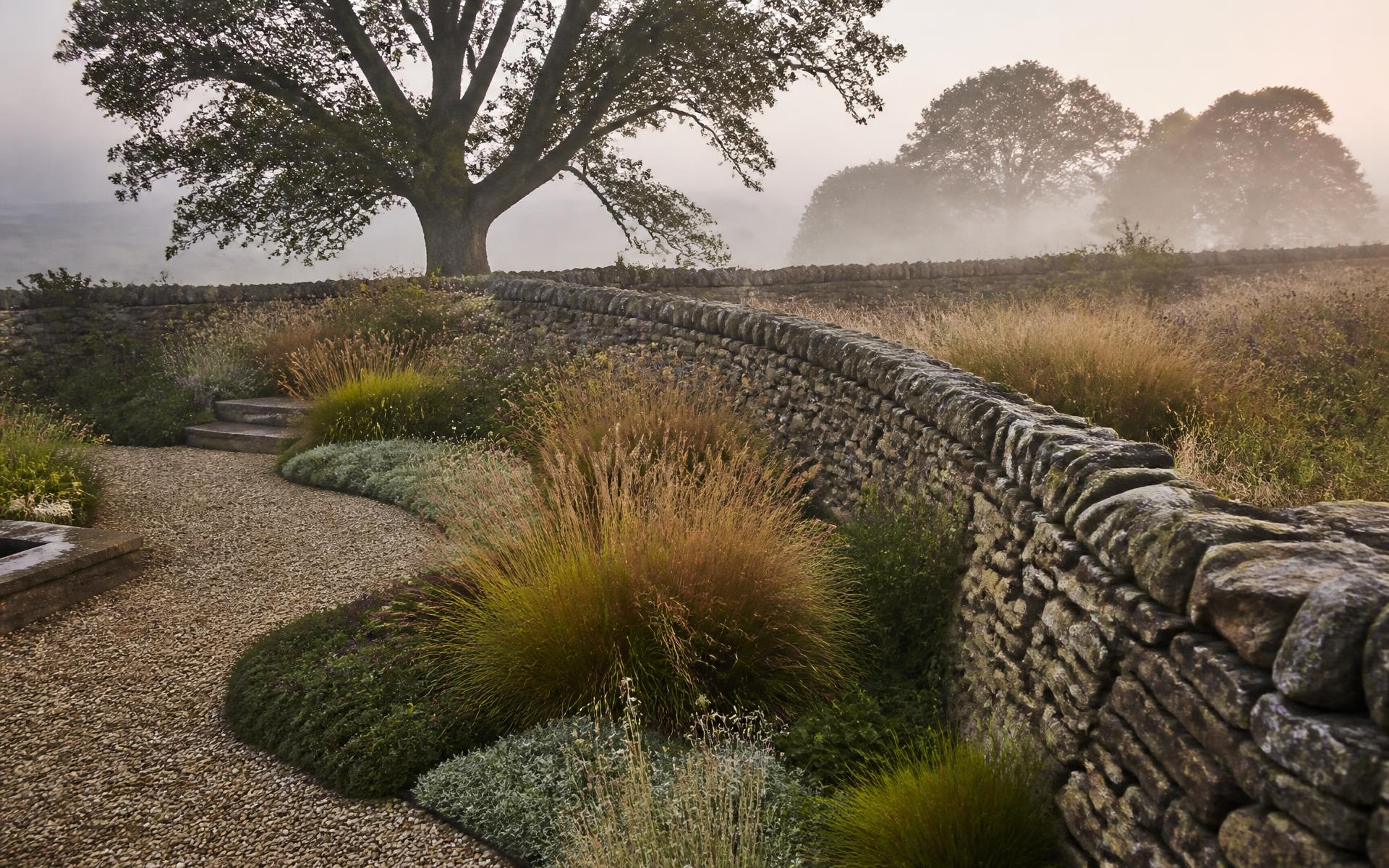
A wall built by hand records the hands.
Drystone walling has no adhesive, no reinforcement and no stated design life. It is expected to stand for two centuries, and generally does.
We keep traditional trades in house because the arithmetic works, and because the difference between competent and exceptional groundwork is visible for decades.
Why beauty
04
It is not decoration. It is retention.
People maintain what they love and neglect what they tolerate. Beauty is therefore the most practical durability strategy available to a landscape.
It is also the reason someone walks a little further, sits a little longer, and brings somebody else next time.
Why landscape changes lives
05
The evidence stopped being contested a decade ago.
Access to good green space measurably alters mental and physical health outcomes. That is settled.
What remains a design problem is distribution: gradient, surface, rest points, sightlines, and whether the route begins somewhere a person can actually reach.
Why communities
06
Because a place belongs to whoever uses it next.
The most valuable landscapes we work on are almost never the most expensive ones. They are the ones held collectively — school grounds, churchyards, community gardens, town squares.
We run that work as its own division, with its own resourcing, so it is never something we get to when commercial work is quiet.
How David works
Landscape designer, architect, master planner, builder — and, when the work requires it, community organiser.
The titles matter less than the sequence: observe, draw, build, and then stay long enough to see whether it worked.